
A Town That Refused to Disappear
The story of Forrest, Victoria, for guests staying at Otways Loft and Steam Carriage
There is something quietly remarkable about Forrest.
It is a small town, a few hundred people, a pub, a brewery, a general store,tucked into the foothills of the Otway Ranges, two hours south-west of Melbourne. It does not announce itself. You arrive along a road that winds through paddocks and tree ferns, and then suddenly there it is: a cluster of weatherboard buildings, a wide sky, the smell of something green and damp coming off the hills.
What makes Forrest remarkable is not what it is now, but what it has been. This is a town that has reinvented itself at least three times, and each time, not through grand ambition or government master plans, but through the stubbornness of the land, the character of the people who stayed, and a certain refusal to become a ghost.
Before the Europeans Arrived
Long before the timber getters and the selectors and the railway engineers, this country belonged to the Gadubanud and Gulidjan peoples. They moved through the Otways along trading routes and story lines that are older than any map we might draw. Many Aboriginal heritage places remain registered in the area, and some local family groups trace their connection to this country to well before European settlement in the 1830s.
It is worth sitting with that for a moment, especially when you are standing in the fern gully at Lake Elizabeth, or watching the mist come off the West Barwon in the early morning. This place has been known and loved for a very long time.
Squatters, Selectors, and the First Farms
In the early nineteenth century, wealthy pastoralists pushed into the Western District of Victoria, following the Barwon River south through Winchelsea and Birregurra. They took up enormous holdings, Yan Yan Gurt at 16,000 acres, Gerangamete at 21,000, Stony Rises at 26,000. The Armitage and Roadknight families were among the first to claim this country.
By the 1860s, colonial governments were beginning to push back. The Land Acts offered settlers the chance to purchase smaller allotments at one pound per acre, and a new class of farmer — the selector — arrived to work the fertile river flats along the West Barwon. They ran mixed farms: cream and piggeries, wheat and oats, potatoes and peas. And, crucially, they planted hops, the first hop fields in the Otways, which would go on to define the rhythm of the town for the next half-century.
Before Forrest itself existed, two small communities grew up to serve these early settlers. Yaugher, a name that turns out to derive not from any Aboriginal word but from a village in Kent, England, where one of the early settlers was born, sat about two kilometres north of where Forrest now stands. It had a school, an Anglican church, and a store. Barramunga, six kilometres to the south, high in the Otways, grew up around the sawmillers beginning to take an interest in the enormous mountain ash forests of the Otways. It had a hotel, a boarding house, a school, a church, and a community hall.
Neither of them survived the arrival of the railway.
The Railway Arrives, and a Town Is Born
In the 1880s, the push for a rail link from Birregurra into the Otway foothills was growing. Farmers needed to get their produce to market. Timber millers needed to get their logs to the city. The local member for Polwarth in the State Legislative Assembly,a man named Charles L. Forrest, took up the cause with considerable determination. He pushed for the line. He argued for it. He made himself something of a nuisance about it, in the way that politicians occasionally do when they are right about something.
By 1884, the government agreed to build the line. The route was surveyed south along the Barwon Valley, and in 1890 the first allotments went on sale in what would become Station Street. The terminus was named Forrest, after the politician who had fought so hard to get it built.

The railway changed everything. Timber mills that had previously been limited by the impossibility of carting logs out on winter roads could now connect to the railhead via an extraordinary network of tramlines, narrow-gauge tracks running deep into the forest, over massive trestle bridges, and through at least one tunnel blasted through a hillside by miners brought up from the Ballarat goldfields. Forrest became the largest timber loading station in the entire Otways, averaging 8,700 tonnes outward per year between 1899 and 1950.

Station Street filled with businesses: the Terminus Hotel, a bakery, a butcher's shop, a general store, government offices for the timber industry. The school moved from Yaugher to the growing township and by 1915 had 95 students enrolled. A new Anglican church was built. A community hall went up at the top of Station Street.
Forrest was, by any measure, a proper town.
The Hop Fields and the Rhythm of the Seasons
Alongside the timber industry, the hop fields gave Forrest its social calendar.
Bertie Ireland's hop paddocks — the Style paddock, the Bridge paddock, the Home paddock, were a fixture of town life from the late 1890s through to the 1940s. At picking time, women and children from across the district would come to work the rows. The work was hard and social in equal measure, a great gathering of town gossip and seasonal labour.
Bertie himself was a teetotaller — which is perhaps ironic, given that he was growing hops for the Geelong Brewery. When Carlton United Brewery acquired the Geelong operation and switched to Tasmanian hops, the Forrest hop fields quietly closed. The paddocks returned to grass.
Between seasons, Bertie would have the ladies of Forrest picking clover flowers for seed. Not a day in clover, as the historical newsletter put it, with a certain dry satisfaction.
The Tiger
By the 1930s, the railway was struggling. Steam trains were expensive to run, and the population of the district was thinning. The solution was a modified Dodge car — fitted with flanged wheels to run on the rail lines, painted in bold diagonal stripes, and accommodating about sixteen passengers. The locals called it the Tiger.
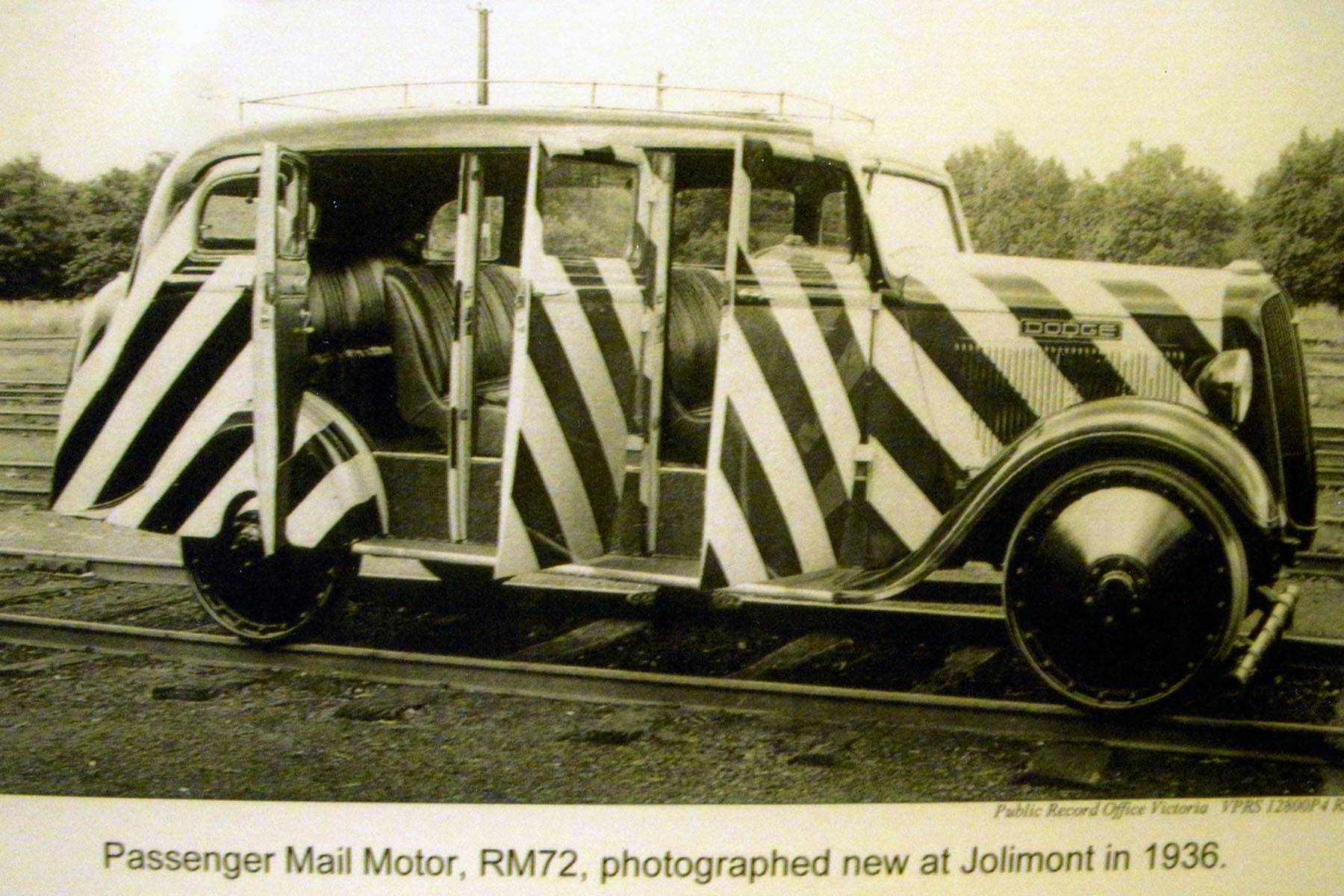 The Tiger (rail motor RM72), photographed new at Jolimont in 1936.
The Tiger ran several times a week between Forrest and Birregurra, carrying passengers, mail, and whatever produce needed moving. It was not, by any account, comfortable. "We didn't look for comfort in those days," one resident recalled, when asked. "Just a way to get around."

Jenny Cunnington (née Curtis) remembered going to the Yaugher station as a girl to meet her aunt and uncle from Melbourne. "To this day the memory is so clear in my mind of them stepping onto the Yaugher Station from the Tiger." You could hear it coming by the noise on the rails, long before you could see it.

The railway line finally closed in March 1957. The Tiger was retired. The tracks were lifted.
The 1939 Fires, and a Town That Contracts
The Black Friday bushfires of January 1939 were catastrophic across Victoria. In the Otways, they burned through settlements that had grown up deep in the forest — the bush mills, the tramline camps, the small communities that had existed in the timber country for decades. The government's response was to declare it unsafe to continue settlements in the bush. The bush mills were to close; milling was to be consolidated in townships.
For Forrest, this was both a loss and a lifeline. The mills that moved into the township became major employers. But the broader community was contracting. Motor vehicles made it easier to shop in Colac. Electricity arrived in the late 1950s, and with refrigerators came the slow death of the local butcher and bakery. The community hall burned down in 1963 and was rebuilt on the main road. Station Street, once the heart of the town, became a quieter place.
The last sawmill in Forrest closed in 2003. The last logging licence in the Otways expired on 30 June 2008 — ending, as the historical society noted, 150 years of native forest logging in the ranges.
The West Barwon Dam, and a Lake That Keeps a Secret
In the early 1960s, the authority responsible for Geelong's water supply decided to build a dam on the West Barwon River, just above the Forrest township. For a few years, construction workers flooded the town, and there was a brief, welcome surge of employment and activity.
The dam created what is now Lake Elizabeth, a quiet, fern-fringed body of water about four kilometres south of town, famous today for its platypus population and its early-morning stillness. It is one of the most reliably lovely places in the Otways, and almost no one outside the district knows about it.
We will not be the ones to change that. But we will tell you: go early, go quietly, and bring something warm to drink.
The Mountain Bikes Arrive
By the end of the twentieth century, Forrest was facing the question that many small Victorian timber towns were facing: what now?
The answer, it turned out, was mountain bikes.
In the early 2000s, with logging winding down and the town's population at its lowest ebb, authorities began investing in trails. Thirty kilometres of purpose-built mountain bike tracks were cut through the surrounding forest. The Otway Odyssey, a 100km and 50km race through the hills was launched in 2007 and brought a thousand riders to Forrest on a single Saturday. Annual events now draw up to 3,000 competitors and visitors each year.
In 2010, siblings Matt and Sharon Bradshaw opened the Forrest Brewing Company in a former timber shed beside the bike trails, with a stated goal of reviving the town. The brewery, casual, seasonal, dog-friendly, and genuinely good, became the social heart of a new Forrest. The Wonky Donkey/Terminus hotel was renovated. A coffee shop and bike store opened. The old guesthouse came back to life.
The town that had been a timber loading station, then a hop-picking centre, then a saw-milling hub, had become something else again: a place people came to on purpose, for the trails and the beer and the ferns and the quiet.
What It Is Now, and Where You Come In
Forrest today is small, but it carries itself with a certain ease. It knows what it is.
The brewery is open on weekends. The general store is good. The Terminus Hotel does a great pub meal. The bike trails are excellent. Lake Elizabeth is twenty minutes down a gravel road, and if you go early enough in the morning you will almost certainly see a platypus.
Accommodation: The Steam Carriage is a 1926 railway carriage that has been here long enough to feel like it belongs. The Otways Loft sits above the ferns, with the forest pressing in close on all sides.
Both of them are, in their own way, a continuation of the story. Forrest has always been a place that repurposes things, timber into houses, trains into transport, trails into tourism, old sheds into breweries. It seems right that a retired railway carriage should end up here, quietly watching the ferns grow.
The Tiger ran its last trip in 1957. But something of its spirit, that particular combination of the practical and the slightly improbable, seems to have stayed.
Mike May 2026
The Forrest and District Historical Society has been collecting and preserving the town's history since 2005. Their newsletters and publications are a wonderful resource for anyone who wants to go deeper. You can find them at forresthistory.org.
All historical images in this post are reproduced courtesy of the Forrest and District Historical Society.